 Little Things
Why Timing Beats Money: The Psychology of Thoughtfulness
Here's a scene. It's a random Tuesday in March. Nothing on the calendar. She walks in from work and there's a small bouquet on the counter — nothing fancy, maybe twelve dollars — with a note that says "saw these and thought of you."
Now a second scene. It's her birthday. There's a beautiful, expensive arrangement on the same counter. It's lovely. She says thank you. She means it.
Ask her about both a year later and she'll tell you about the Tuesday.
The math of "expected"
The reason isn't complicated, and it isn't a trick. A gift on a designated gift-giving day carries a silent asterisk: you were supposed to do this. It can still be wonderful, but the baseline is high. At best you met expectations gracefully. At worst — if it's rushed, generic, or late — you fell short of a bar everyone could see.
An unprompted gesture has no asterisk. Nobody scheduled it. There was no social pressure, no reminder from a greeting-card aisle. Which means the gesture can only be explained one way: you were thinking about her when you didn't have to be. That's the entire message, and it's the message people most want to receive.
Researchers who study gift-giving keep landing on versions of the same finding: recipients care far less about price than givers assume, and far more about how well a gift shows the giver knows them. Price is a fact about your wallet. Timing and specificity are facts about your attention. Only one of those is romantic.
Why the wrong moment wastes the right gift
Timing cuts the other way too. The same gesture, landed badly, can shrink to almost nothing. Flowers that arrive two days after the anniversary don't say "I love you" — they say "I remembered that I forgot." A gift handed over mid-argument reads as a payment, not a present. The object didn't change. The moment did.
This is why "I'll just spend more" is such a losing strategy. Money can't buy back a missed moment; it can only draw attention to it. A bigger bouquet after a forgotten birthday is a bigger apology.
The good news: timing is learnable
Most of us aren't unthoughtful. We're busy. The care is there; the calendar awareness isn't. Work gets loud, weeks blur, and suddenly the anniversary is tomorrow. The fix isn't becoming a different person — it's building a small system so the moments stop sneaking up on you:
- Write the dates down once. Birthday, anniversary, the day you met. Not in your head — somewhere that will tap you on the shoulder early enough to actually do something good.
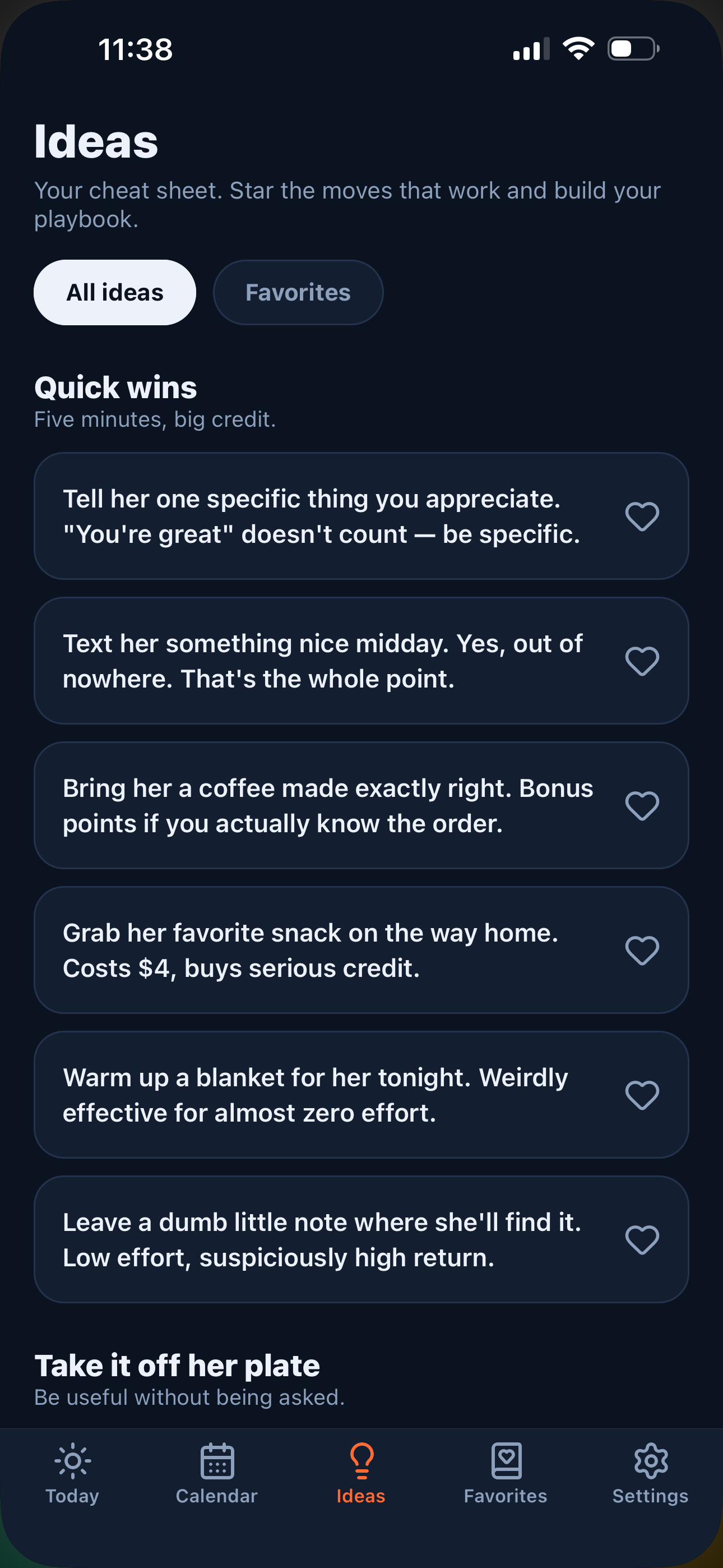
- Schedule the unscheduled. It sounds like cheating. It isn't. Deciding "I do one just-because thing a week" is a commitment to attention. The gesture is still real when it happens.
- Keep the specifics somewhere. Her coffee order, the flowers she actually likes, the takeout she orders when it's been a long week. Specificity is what turns a generic gesture into proof you were listening.
- Go small and often over big and rare. Ten twelve-dollar Tuesdays beat one grand gesture a year. Frequency is what tells her this is who you are, not something you did once.
Thoughtfulness was never about the receipt. It's about being the person who noticed — and noticing at the right moment is a skill you can simply decide to have.